

🧩 Inference Phase Field
Operational Validation of Inference-Phase Dynamics
Estimated reading time: ~10 minute
Operational Validation
Overview
🔬 Inference Phase Field (IPF Microcosm V1) is the companion instrument to Zero State Field (ZSF) — but instead of simulating dynamics in a synthetic substrate, IPF walks straight into real inference.
Where ZSF shows that Recursive Science dynamics are substrate-invariant in a controlled numerical microcosm, IPF asks a different question:
Do those same field-like regimes, basins, and collapse patterns appear inside live model inference — across architectures, providers, and stacks — when we treat inference as a trajectory instead of a black box?
IPF is not:
a model,
a fine-tuning framework,
or a new inference stack.
IPF is a field console that consumes worldline logs from any model and reveals:
how its internal state evolves under recursion,
which regimes it visits (Stable, Transitional, Phase-locked, Collapse),
whether identity-like basins form,
and what that implies for safety and stability.
It does this without touching weights, prompts, or training data.
1️⃣ What IPF Is
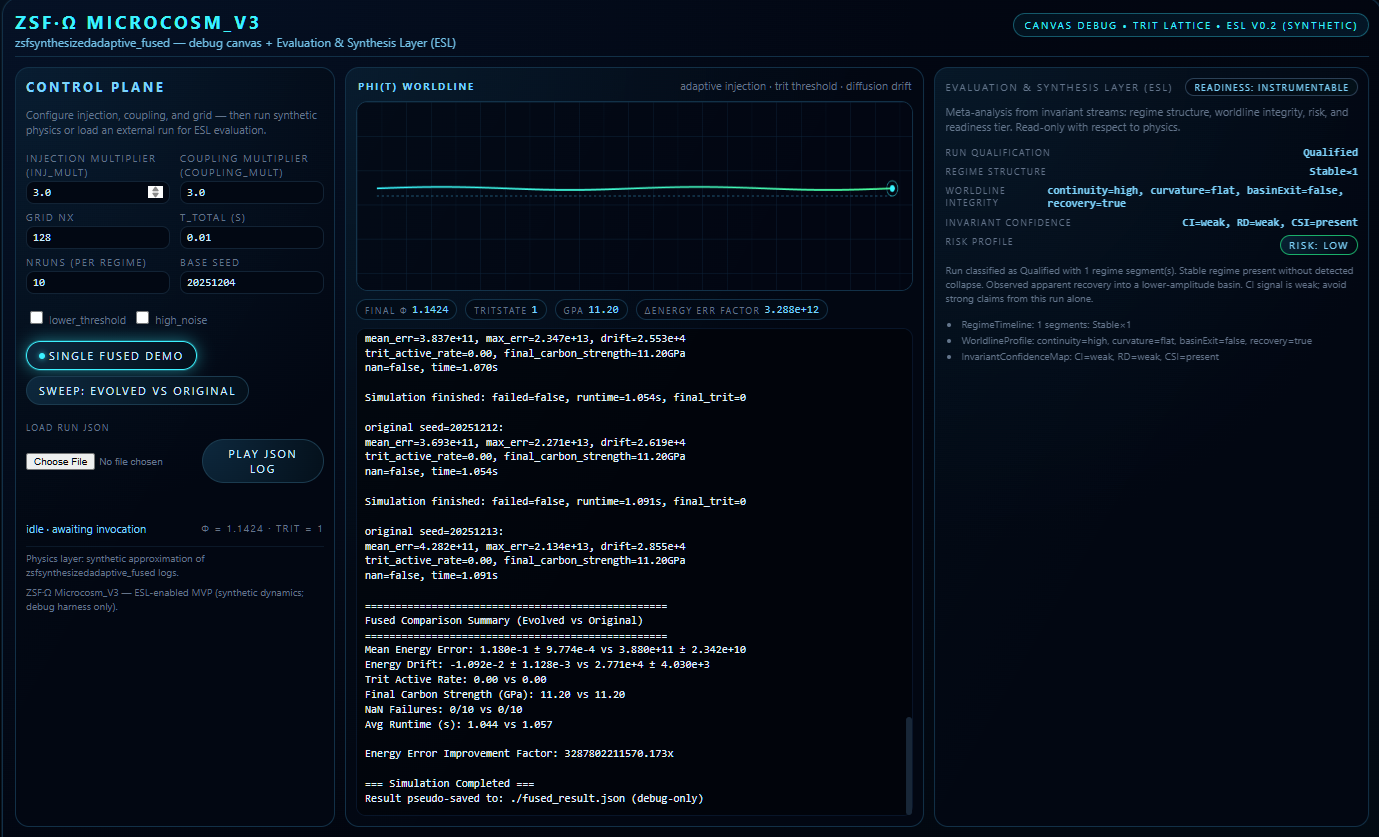
IPF Microcosm V1 is a single-page, model-agnostic instrument that:
Accepts worldline JSON logs from any model or agent pipeline.
Treats each run as a trajectory s0,s1,…,sTs₀, s₁, …, s_Ts0,s1,…,sT in an inference field.
Computes and visualizes key invariants from Recursive Science:
curvature κ(t)
echo strength (Echo(t))
contraction Π(t)
Segments behavior into regimes:
Stable
Transitional
Phase-locked
Collapse / Turbulent
Generates a structured ESL (Evaluation & Synthesis Layer) report with:
RegimeTimeline
WorldlineProfile
InvariantConfidenceMap
Risk / Readiness assessment
Like ZSF, IPF is explicitly:
non-interventional (observer only),
offline-capable,
deterministic / seed-driven when used with fixed pipelines,
and built to be portable across labs.
You can run it locally in a browser and feed it logs from any stack that can export vectors over time.
2️⃣ What IPF Tests
IPF is designed to make a narrow set of claims testable:
Inference as a Field, Not a Call
It treats inference as a worldline:
each step is a point in a latent field,
the sequence is a path with curvature, shear, and basins.
Recursive Intelligence (RI) vs One-Shot Behavior
Contrasts:
One-shot inference
Shallow recursion
Full NOESIS-style recursive protocols
Shows where new capabilities / identities only appear under certain recursion depths and field conditions.
Identity & Attractor Structure
Detects when a trajectory:
bends into a stable corridor,
exhibits strong echoes,
shows contraction into a basin.
Distinguishes:
identity-bearing regimes
from random walk / drift-dominated behavior.
Inference-Phase Dynamics vs Hyperparameters
Focuses on field metrics (κ, Echo, Π, regimes) rather than:
temperature,
top-p,
or other sampling hyperparameters.
Demonstrates cases where hyperparameter changes don’t explain behavior, but field invariants do.
Falsifiability and Cross-Model Comparisons
Same instrument can be applied to:
GPT-class models,
open-source transformers,
in-house stacks,
or future architectures.
Either:
the predicted field structure appears (supporting Recursive Science claims), or
it doesn’t (falsifying stronger interpretations).
3️⃣ How IPF Works (High-Level)
3.1 Worldline Logs
IPF expects logs in a simple JSON shape, e.g.:
{
  "meta": {
    "model": "your-model-id",
    "protocol": "recursive",
    "seed": 20251204
  },
  "steps": [
    { "step": 0, "vec": [ ... ], "kappa": 0.03, "echo": 0.12, "pi": 0.87 },
    { "step": 1, "vec": [ ... ], "kappa": 0.02, "echo": 0.15, "pi": 0.90 }
  ]
}
Each step represents one inference-phase state:
vec: embedding / hidden-state representation of the system at that step,optional per-step invariants (κ, Echo, Π) if computed upstream.
Labs can:
export embeddings or pooled hidden states,
or supply 2D projections directly (
x,y).
IPF does not need access to logits, weights, or internals beyond whatever you choose to log.
3.2 Field View & Regimes
Inside the app, IPF:
Projects
vecto 2D/3D for visualization.Renders a trajectory with:
color by time or recursion depth,
thickness/glow by echo / contraction.
It then builds a RegimeTimeline, segmenting the run into:
Stable: low drift, consistent basin behavior.
Transitional: shifting curvature, regime boundary exploration.
Phase-locked: identity basin locked, behavior highly coherent.
Collapse / Turbulent: high drift, regime breakdown, or fragmentation.
These are visible both as:
a color bar over time,
and structured JSON in the ESL report.
3.3 Evaluation & Synthesis Layer (ESL)
The ESL layer is IPF’s meta-analytic brain. It:
Consumes invariants and regime segments,
Builds a WorldlineProfile:
continuity vs fragmentation,
basin entry/exit,
recovery vs non-recovery,
Assesses InvariantConfidenceMap:
whether κ, Echo, Π are:
absent,
weak,
present,
or diagnostic,
Synthesizes a Risk / Readiness profile:
Risk band:
Low / Medium / High
Readiness tier:
Exploratory
Researchable
Instrumentable
All of this is exportable via a tiny “Download ESL Report (JSON)” button for archival, audit, and cross-lab comparison.
4️⃣ Operators, Observables, and Variables
IPF implements a concrete subset of Recursive Science’s operators and observables — in a form labs can work with.
4.1 Curvature κ(t)
Measures how sharply the worldline bends in latent space.
High curvature spikes:
correlate with regime transitions or basin entry/exit.
Flat κ(t):
suggests either a very stable basin
or a non-dynamic system with little recursive structuring.
4.2 Echo Strength
Captures how strongly current states “remember” prior states.
High echo in a stable corridor:
signature of identity-bearing regimes.
High echo in turbulent regions:
can signal pathological loops.
4.3 Contraction Π(t)
Tracks whether states are:
converging into a basin,
or diverging into drift.
Strong contraction:
indicates a basin / identity attractor forming.
Persistent lack of contraction:
suggests no stable identity structure in that region.
4.4 Regime Labels & Worldline Continuity
IPF tags each time segment with a regime label.
Worldline continuity metrics:
detect fragmentation (e.g., sudden resets),
distinguish true recovery vs apparent recovery.
These are not generic analytics; they are the operationalization of your published invariants and regime taxonomy in a tool labs can run without adopting the entire ontology.
5️⃣ Why This Matters for AI Safety & Stability
Safety and alignment discussions often focus on:
loss curves,
benchmark scores,
or prompt-level evaluations.
IPF points at a different layer:
What is the model actually doing as a dynamical system when we let it think over time?
Specifically, IPF enables labs to:
Detect brittle vs healthy recursive regimes
Identify when a system:
stays in stable, well-structured basins under recursion, or
falls into drift, collapse, or pathological loops.
Measure early-warning signals
Field metrics often move before surface failure:
curvature patterns,
echo disruptions,
contraction breakdown.
This creates space for upstream safety interventions (at design / deployment time, not runtime control).
Compare models and mitigations in field terms
Two models with similar benchmarks can have very different worldline behavior under recursion.
IPF exposes those differences and gives a way to evaluate:
mitigation techniques,
safety strategies,
agent architectures.
Standardize inference-phase reporting
ESL reports provide a common language for:
“Is this system stable under recursive use?”
“Which regimes does it actually visit?”
“What’s the risk profile of this configuration?”
IPF doesn’t solve alignment by itself.
It makes inference-phase dynamics legible and testable, which is a prerequisite for any serious safety program in recursive systems.
6️⃣ Relationship to ZSF, Stability Trial, and FieldLock
You can think of the ecosystem this way:
ZSF Microcosm (Ω)
Substrate externalization: shows the physics is not tied to transformers.IPF Microcosm (Inference Phase Field)
Inference-phase instrument: probes live models to see how those dynamics manifest in practice.Inference-Phase Stability Trial
Structured protocol: uses IPF-style metrics across many runs to test reproducibility and substrate invariance.FieldLock (Product Layer)
Safety infrastructure: turns these measurements into deployable guardrails and policies (without IPF itself performing control).
IPF sits at the bridge:
from theory and synthetic validation (ZSF)
to real-world models and eventual production safety infrastructure (FieldLock / SubstrateX). Relationship to ZSF, Stability Trial, and FieldLock
You can think of the ecosystem this way:
ZSF Microcosm (Ω)
Substrate externalization: shows the physics is not tied to transformers.IPF Microcosm (Inference Phase Field)
Inference-phase instrument: probes live models to see how those dynamics manifest in practice.Inference-Phase Stability Trial
Structured protocol: uses IPF-style metrics across many runs to test reproducibility and substrate invariance.FieldLock (Product Layer)
Safety infrastructure: turns these measurements into deployable guardrails and policies (without IPF itself performing control).
IPF sits at the bridge:
from theory and synthetic validation (ZSF)
to real-world models and eventual production safety infrastructure (FieldLock / SubstrateX).
🔬 For Research Labs
How to Engage or Replicate
IPF is designed to be adoptable without coordination.
6.1 What You Do Not Need
No access to training data.
No access to weights.
No changes to your production systems.
No adoption of a new inference framework.
6.2 What You Do Need
A way to:
run your model over a horizon (multi-step / recursive scenario),
export a sequence of internal states or embeddings as a JSON log.
Basic ability to:
add a logging function around your existing inference loop,
dump
steps[]with state vectors and optional metrics.
6.3 Minimal Engagement Path
Pick a model & scenario:
e.g., an agent loop, long-context reasoning, tool-using chain.
Implement one logging wrapper:
Store embeddings/hidden states each step into a JSON
steps[]array.
Run a small batch of seeds:
e.g., 10–20 runs with variation in seeds / prompts.
Load logs into IPF Microcosm V1:
Use the browser app locally.
Inspect worldlines and ESL outputs.
Decide on follow-up:
Attempt deeper validation,
Compare models or mitigations,
Publish internal findings or coordinate on external replication.
6.4 For Formal Collaborations
If your lab wants to:
perform structured validation,
extend IPF with custom observables,
link IPF outcomes with ZSF / FieldLock programs,
you can:
reference “IPF Microcosm – inference-phase field validation” in your outreach, and
request access to:
reference schemas,
sample logs,
internal evaluation templates.
How to Engage
If your lab wants to:
attempt an independent replication
extend validation to new substrates
publish external confirmation
review the following Lab materials first:
Recursive Dynamics Lab
experimental scope and validation postureObservables & Invariants
the canonical measurement vocabularyInstrumentation
Φ / Ψ / Ω measurement systemsEvaluation Rubric
regime classification and reporting standardExternal Validation & Replication
this page is the official handoff interface for labs
Then use the Connect page and reference:
“ZSF Validation - independent replication”
You will be directed to the appropriate validation artifacts, repositories, schemas, and coordination pathway.
🧩 Quick Links
If you’re new
🧭 What Is Inference-Phase AI
What inference is, why it matters, and why it constitutes a new scientific domain.
🧠 Primer in 10 Minutes
A fast, structured introduction to Recursive Science and inference-phase dynamics.
📘 Glossary
Canonical definitions for regimes, drift, curvature, worldlines, and invariants.
If you’re exploring the science
🏛 About Recursive Science
Field definition, stewardship, standards, and scientific scope.
🏫 Recursive Intelligence Institute
Institutional research body advancing Recursive Science across formal phases.
↳ Research programs, canon, publications, and thesis structure.
📚 Research & Publications
Manuscripts, frameworks, and the Recursive Series forming the Phase I canon.
If you’re technical or validating claims
🔬 Recursive Dynamics Lab
Instrumentation, experiments, and validation pathways.
🧪 Operational Validation (ZSF)
Substrate-independent validation of inference-phase field dynamics.
📊 Inference-Phase Stability Trial (IPS)
Standardized, output-only protocol for regime transitions and predictive lead-time.
📐 Observables & Invariants
The measurement vocabulary of Recursive Science.
🧭 Instrumentation
Φ / Ψ / Ω instruments for inference-phase and substrate dynamics.
📏 Evaluation Rubric
The regime-based standard used to classify stability, drift, collapse, and recovery.
If you’re industry or applied infrastrcuture
🛡 AI Stability Firewall
High-level overview of inference-phase stability and monitoring.
🏗 SubstrateX
Applied infrastructure derived from validated research.
📄Industry Preview White Paper
How inference-phase stability reshapes AI deployment in critical environments